Most founders I work with can quote their monthly revenue from memory. Ask them their breakeven point, though, and you’ll get a guess, a shrug, or worse — a number that’s confidently wrong.
That’s a problem. Because your breakeven point isn’t just an accounting metric. It’s the line between running a businessand running on hope.
Let’s fix that today.
What Breakeven Actually Means
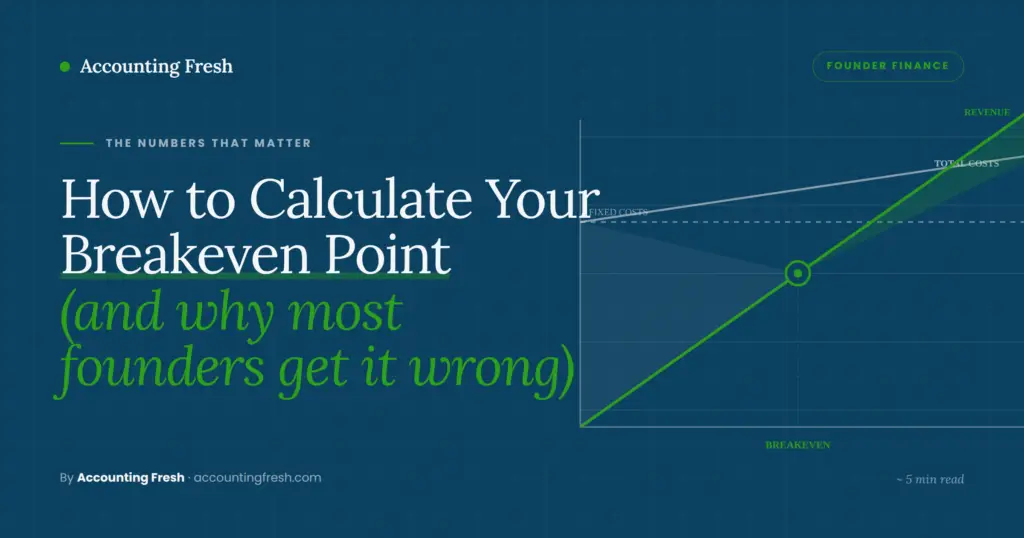
Your breakeven point is the exact amount of revenue you need to cover all your costs — no profit, no loss. It’s the number where your business stops bleeding and starts breathing.
Below it: you’re losing money. Above it: you’re building wealth.
Simple in theory. But here’s where founders go sideways.
The Formula (The Real One)
Here’s the equation you’ll see in every textbook:
Breakeven Point (in units) = Fixed Costs ÷ (Price per Unit − Variable Cost per Unit)
Or, if you want it in dollars:
Breakeven Revenue = Fixed Costs ÷ Contribution Margin %
That looks clean. The problem is that almost every founder fills in the wrong numbers.
The 4 Mistakes That Wreck the Calculation
1. Forgetting to pay yourself
If your “fixed costs” don’t include a market-rate salary for the work you’re doing, you’re not calculating a breakeven point — you’re calculating how cheap your business looks on paper. A breakeven that ignores founder pay is a breakeven that keeps you broke.
2. Mixing up fixed and variable costs
Rent, software subscriptions, insurance — those are fixed. They show up whether you sell one unit or one thousand. Materials, payment processing fees, shipping, contractor labor tied to specific projects — those are variable. They scale with sales. Mislabel them and your math falls apart.
3. Using gross revenue instead of contribution margin
Selling a $100 product doesn’t mean you have $100 to cover overhead. If the product costs $40 to make and deliver, you have $60 — that’s your contribution margin. Run breakeven off the $100 and you’ll set targets you can never hit.
4. Treating it as a one-time calculation
Your costs change. Your pricing changes. Your product mix changes. A breakeven point you calculated 18 months ago is a museum piece, not a management tool. Recalculate quarterly at minimum.
A Real Example
Say you run a service business with these numbers:
- Monthly fixed costs (including your salary, rent, software, insurance): $15,000
- Average project price: $2,500
- Variable costs per project (contractors, materials, fees): $750
Contribution margin per project = $2,500 − $750 = $1,750
Breakeven = $15,000 ÷ $1,750 = 8.57 projects per month
That means you need to close 9 projects every month just to keep the lights on. Project 10 is where profit starts.
Now you have a real target — not a vibe.
Why This Number Changes Everything
Once you know your breakeven, every business decision gets sharper:
- Pricing: You can model exactly how a price change moves your breakeven.
- Hiring: You know how much new revenue a new hire needs to generate.
- Marketing spend: You know how many sales an ad campaign needs to produce to be worth it.
- Sleep: You stop wondering if you’re profitable. You know.
The Bottom Line
Most founders don’t get their breakeven point wrong because the math is hard. They get it wrong because they’re using sloppy inputs — undercounting costs, underpaying themselves, and overstating margin.
Run the numbers honestly, recalculate every quarter, and you’ll trade anxiety for a roadmap.
If you want help running your real breakeven — with your actual numbers, not the optimistic ones — that’s exactly what we do at Accounting Fresh.